ABUJA, Nigeria, 19 October 2026 – How can Nigeria ensure that farmers get greater value from every unit of fertilizer they apply?
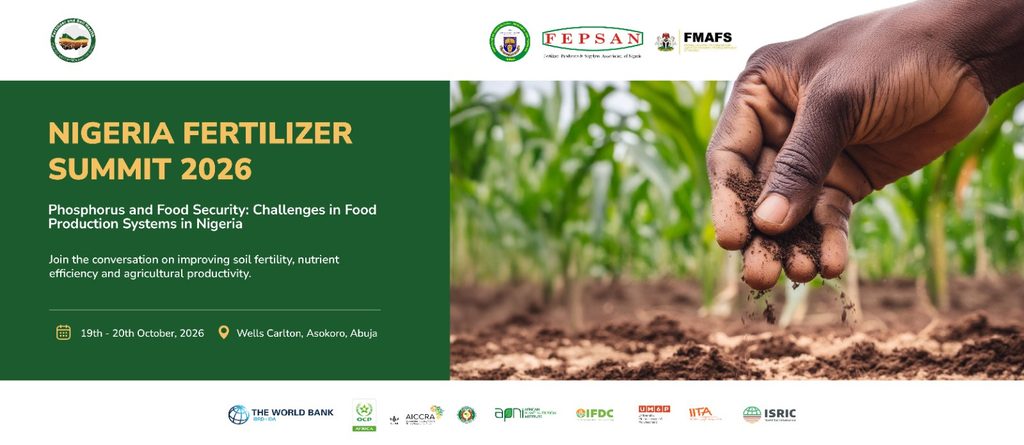
This question is at the centre of the Technical Workshop on Strategic Phosphorus Use in Nigeria, taking place on 19-20 October 2026 at the Wells Carlton Hotel in Abuja.
Bringing together researchers, policymakers, fertilizer manufacturers, regulators and development partners, the workshop will examine how better soil information, more precise nutrient recommendations and stronger collaboration across science, industry and government can improve phosphorus management and strengthen food security.
Held under the theme “Phosphorus and Food Security: Challenges in Food Production Systems in Nigeria,” the workshop builds on a national dialogue initiated in October 2025 and seeks to advance practical solutions to longstanding fertilizer and soil-fertility challenges.
The challenge: Why more fertilizer is not always the answer?
Phosphorus is essential for root development, crop growth and grain formation. Yet its availability to crops varies considerably depending on soil properties, farming practices and local growing conditions.
For farmers, this creates an important challenge. Applying too little phosphorus can limit crop productivity, while applying more than crops require can increase production costs without delivering corresponding yield benefits.
The challenge is therefore not simply increasing fertilizer use, but ensuring that farmers have access to appropriate fertilizers and reliable guidance on where, when and how much to apply.
Evidence from the Regional Hub for Fertilizer and Soil Health for West Africa and the Sahel highlights the need for fertilizer recommendations that reflect local conditions. The Hub’s 2025 site-specific nutrient recommendation results for maize and rice in northern Nigeria show that phosphorus requirements can vary from zero to over 60 kg P₂O₅ per hectare within the same target area. These findings demonstrate that uniform fertilizer rates may not meet crop nutrient needs efficiently, underscoring the importance of tailoring recommendations to local soil conditions and crop requirements.
Improving phosphorus management will require more than agronomic research alone. It also depends on accessible soil information, appropriate fertilizer formulations, effective quality assurance, extension services and investments that translate scientific evidence into practical recommendations.
Turning soil information into better fertilizer decisions
The Regional Hub for Fertilizer and Soil Health for West Africa and the Sahel is contributing to this agenda by strengthening the evidence and decision-support systems needed for more efficient nutrient management.
Its work focuses on three interconnected areas: improving soil information, developing locally adapted nutrient recommendations and supporting digital advisory tools that help translate research into practical fertilizer decisions.
Making soil information more useful
The Hub is developing enhanced digital soil maps that include key soil properties such as available phosphorus. By combining existing soil records with new field observations, the initiative seeks to provide more detailed information on nutrient availability and soil conditions.
This information can support more precise fertilizer recommendations, agricultural planning and investment decisions.
The Hub is also supporting national soil information systems in Nigeria, Ghana, Liberia, Sierra Leone and Togo, while contributing to the development of a regional soil information platform that will improve access to soil data and decision-support resources.
Moving beyond blanket fertilizer recommendations
The Hub is supporting the development of site-specific nutrient recommendations using evidence from field trials and historical crop-response records.
This work accounts for differences in soil conditions, crop requirements and local production environments, helping agricultural advisers and farmers make more informed nutrient-management decisions.
These recommendations are being validated and integrated into AKILIMO 2.0, a digital advisory platform that combines nutrient recommendations with practical agronomic guidance.
Together, these efforts aim to help farmers improve fertilizer-use efficiency and make more informed decisions about agricultural inputs.
From scientific evidence to policy and investment
Better soil information only creates value when it informs decisions throughout the agricultural system.
Researchers need to translate soil and crop-response data into reliable recommendations. Fertilizer manufacturers and blenders need information that can guide product development and formulation. Policymakers and regulators need evidence to strengthen fertilizer quality, agricultural advisory systems and investment priorities.
Farmers and extension services, in turn, need recommendations that are practical, affordable and relevant to local conditions.
“Improving phosphorus management is not simply about increasing fertilizer application. It is about understanding what different soils and crops need and management requirement to achieve optimal efficiency and ensuring that farmers have access to the right products and best advice. Through better soil information, locally adapted nutrient recommendations and supporting agronomic management delivered thorough digital advisory tools, the Regional Hub is helping build the evidence needed for more efficient fertilizer use. The next step is connecting that evidence with policy, industry and extension systems so that it can support decisions on the ground.”- Dr Bello Muhammad Shehu, Senior Agronomist Regional Hub for Fertilizer and Soil Health for West Africa and the Sahel
Building a coordinated national response
The workshop builds on the October 2025 national phosphorus dialogue, which identified constraints including limited soil testing, generalized fertilizer recommendations, fertilizer-quality concerns, inadequate extension services and weak stakeholder coordination.
That dialogue also endorsed the establishment of the Nigeria Fertilizer Phosphorus Network (NFPNet), with its secretariat hosted at the Institute of Agricultural Research and Training (IAR&T).
The 2026 workshop will examine five interconnected priorities:
- Data-driven phosphorus management
- Fertilizer production and blending
- Quality standards and regulation
- Soil phosphorus dynamics and nutrient-use efficiency
- Policy and investment pathways
Discussions are expected to consider proposals for a national phosphorus action plan, greater integration of digital advisory tools into agricultural systems, and stronger collaboration around fertilizer products adapted to different soil and crop conditions.
These outcomes could provide a foundation for more coordinated phosphorus management in Nigeria, subject to agreement by participating stakeholders.
Partnerships for lasting impact
The workshop is organized by the Institute of Agricultural Research and Training (IAR&T), Obafemi Awolowo University (OAU) and the Fertilizer Producers and Suppliers Association of Nigeria (FEPSAN), with the Fertilizer and Inputs Support Services Department of the Federal Ministry of Agriculture and Food Security serving as co-convener.
It brings together institutions working across agricultural research, fertilizer manufacturing, soil science, regulation, policy and development.
For the Regional Hub, the workshop provides an opportunity to contribute technical evidence, exchange experience and strengthen collaboration around more efficient nutrient management.
The broader ambition is to move beyond isolated technical interventions towards coordinated systems that make soil information more accessible, fertilizer recommendations more relevant and investments more responsive to agricultural needs.
À propos du Centre régional pour les engrais et la santé des sols en Afrique de l'Ouest et au Sahel
Established in June 2024 and endorsed as an ECOWAS sub-program, the Regional Hub provides technical assistance to support fertilizer and soil health investments across 17 countries in West Africa and the Sahel.
Hosted at the IITA campus in Ibadan, Nigeria, the Hub operates under ECOWAS governance and is jointly managed by IITA, APNI, IFDC, Mohammed VI Polytechnic University (UM6P) and ISRIC, with support from the World Bank and OCP Africa.
The Hub supports countries through 20 technical functions across six thematic areas, connecting scientific evidence, institutional capacity, policy support and regional collaboration.
More information: https://regionalhub-west.org/