Liberia’s agricultural future rests, quite literally, on the health of its soils. Yet for decades, the country has relied on limited and outdated soil data, making it difficult for farmers, researchers, and policymakers to make informed decisions. The last comprehensive soil survey in Liberia dates back to the 1970s. Since then, environmental, climatic, and land-use changes have rendered much of the available data inadequate for present-day agricultural planning and productivity improvement.
For Liberia’s stakeholders, this information gap has translated into poor fertilizer decisions, declining productivity, low returns on investment, and limited access to the scientific knowledge needed to improve agricultural outcomes.
To address these challenges, the Regional Hub for Fertilizer and Soil Health for West Africa and the Sahel, hosted by the International Institute of Tropical Agriculture (IITA), is supporting efforts to strengthen soil information systems and soil management practices across the country. Working in collaboration with local institutions — including Liberia’s Ministry of Agriculture, the Central Agricultural Research Institute, and the University of Liberia — alongside international partners such as IITA, the International Soil Reference and Information Centre (ISRIC), and MATE University under the EU-funded Soils4Liberia Project, the initiative is helping Liberia build modern systems capable of supporting evidence-based agricultural development and long-term soil health management.
Building Liberia’s Digital Soil Intelligence
A central component of the initiative is the development of a nationwide digital soil information system. Under the digital soil mapping component, the project is conducting a nationwide soil survey to generate scientifically validated soil information for Liberia — including agricultural land suitability assessments, quantification of soil health indicators, and analysis of how soil properties vary across the country. The goal is to give farmers, researchers, policymakers, and other stakeholders accurate, accessible soil information to support better agricultural planning and decision-making.
The process began with a comprehensive sampling design, followed by training local experts in modern digital tools and techniques for soil survey and data collection. With training now complete, field teams are conducting nationwide soil sampling campaigns across the country.
“These efforts are helping us move from outdated and fragmented soil information systems to modern digital soil intelligence that can support agricultural transformation,” said Dr. Samuel Mesele, soil scientist with IITA and the Regional Hub’s country focal person for fertilizer and soil health in Liberia.
The nationwide survey is expected to generate critical data to support sustainable land management, improved fertilizer recommendations, and more efficient agricultural investment decisions across Liberia.
Strengthening Liberia’s Soil Laboratory Capacity
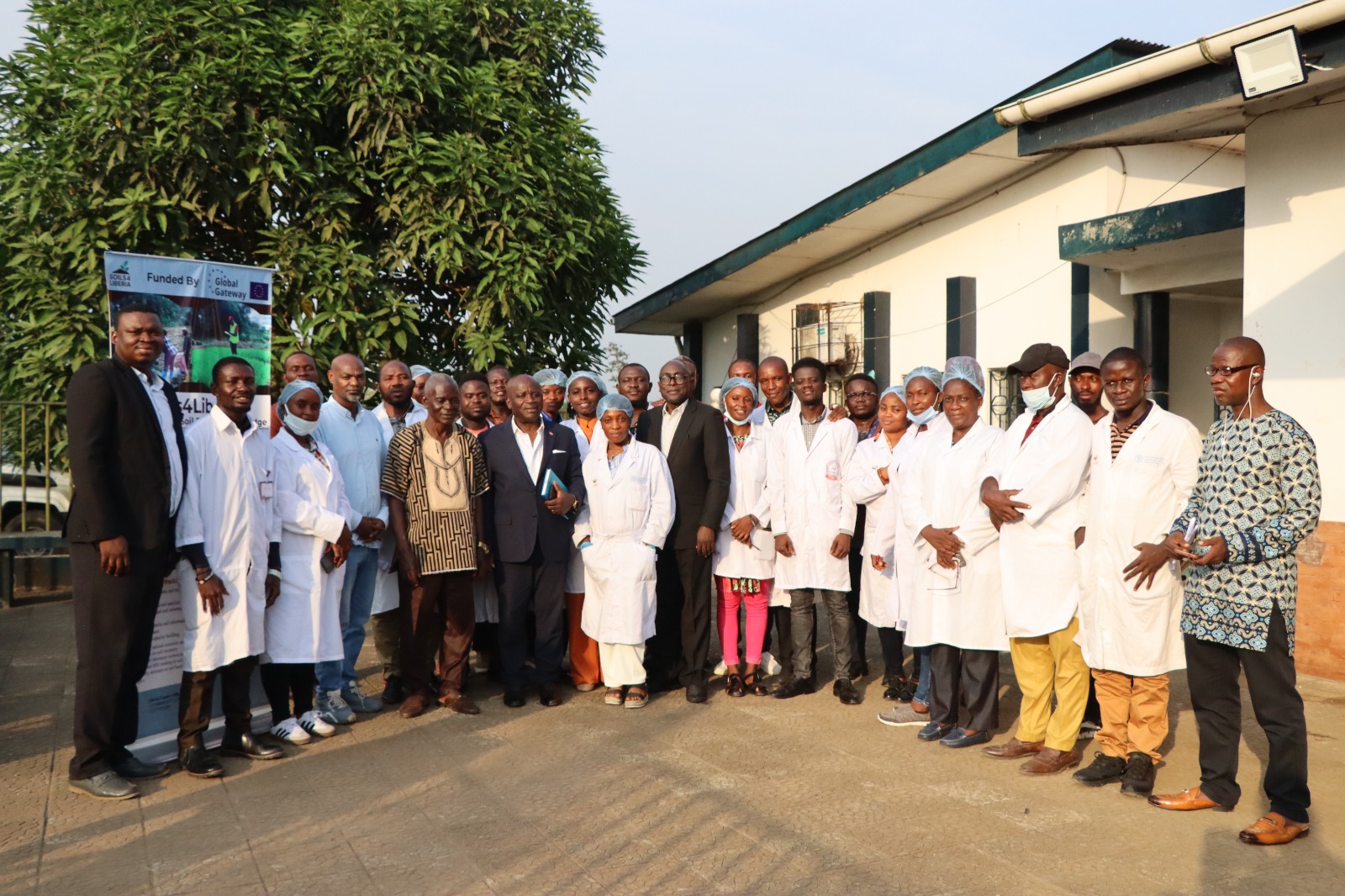
Another gap the initiative is addressing is the absence of a fully functional reference soil laboratory capable of conducting advanced soil analyses and nutrient assessments in Liberia. To close this gap, the Regional Hub and the Soils4Liberia Project are supporting efforts to strengthen laboratory infrastructure and technical capacity, particularly at the University of Liberia.
Preliminary assessments identified existing gaps in laboratory infrastructure, equipment, and technical expertise, and work has since been underway to establish a functional, sustainable soil analysis system in the country. Laboratory technicians have received extensive training in analytical procedures, equipment handling, laboratory management, quality assurance, and standard operating procedures (SOPs). New laboratory equipment has also been procured and installed to expand analytical capability — among the most significant additions is an Atomic Absorption Spectrometer (AAS), an essential instrument for elemental nutrient analysis.
“Without this kind of equipment, a laboratory cannot be considered fully functional for modern soil analysis,” Mesele noted.
Beyond equipment installation, the initiative is focused on building long-term institutional and technical capacity — strengthening Liberia’s ability to conduct reliable soil analysis and supporting the country’s future agricultural research and development.
Moving Beyond Blanket Fertilizer Recommendations
For years, fertilizer use in Liberia has relied largely on blanket recommendations that fail to account for differences in soil properties, agroecological conditions, land-use systems, and farmers’ socioeconomic realities. But soil conditions vary significantly by location — a fertilizer recommendation that works well in one area may not produce the same results elsewhere.
To address this, the Regional Hub supported field trials to develop site-specific nutrient recommendations tailored to local conditions and farming realities. The trials were established across three counties — Bong, Margibi, and Lofa — and implemented in 50 farmer-led and sector-supported fields beginning in July 2025, with a focus on rice production given its status as Liberia’s major staple food crop. The trials were designed to identify nutrient limitations affecting rice productivity and to determine the most effective fertilizer combinations for different locations and soil conditions.
According to Dr. Samuel A. Mesele, the project lead in Liberia, field experiments are now complete, and data analysis and synthesis are ongoing. Validation trials have also begun in 25 farmers’ fields across the country. Because the trials are implemented directly within farmers’ production systems, the findings are expected to reflect real farming conditions and be more readily adopted by local communities.
What This Means for Farmers
The initiative is expected to deliver tangible benefits to farmers across Liberia by giving them access to accurate soil and nutrient information that supports more informed decision-making at the farm level. Armed with this knowledge, farmers will be better positioned to optimize fertilizer application, improve soil management practices, and strengthen their crop production systems. Over time, these improvements are expected to translate into higher yields, increased profitability, better returns on investment, and more resilient, sustainable livelihoods.
Farmer training and knowledge transfer remain central to the initiative. “Agriculture is fundamentally science-driven,” Mesele explained. “Improving farmers’ knowledge is essential for achieving higher productivity and profitability.”
By combining scientific research, digital soil information systems, laboratory strengthening, and farmer-centered field trials, the initiative is helping build a stronger foundation for agricultural transformation in Liberia.
Building a More Resilient Agricultural Future
The work being implemented through the Regional Hub and the Soils4Liberia Project extends beyond short-term interventions. It is helping establish foundational systems that will support sustainable land management and strengthen agricultural decision-making across Liberia for years to come.
Through partnerships involving IITA, the Regional Hub for Fertilizer and Soil Health for West Africa and the Sahel, Soils4Liberia, national institutions, and international collaborators, Liberia is steadily building the scientific infrastructure and technical capacity needed to support a more productive, data-driven, and sustainable agricultural future.
About the Regional Hub for Fertilizer and Soil Health
The Regional Hub for Fertilizer and Soil Health for West Africa and the Sahel is a collaborative initiative bringing together leading research, development, and private-sector partners to deliver science-driven solutions for sustainable agriculture. Hosted by the International Institute of Tropical Agriculture (IITA) and supported by organizations including the International Fertilizer Development Center (IFDC), OCP Africa, the African Plant Nutrition Institute (APNI), University Mohammed VI Polytechnic (UM6P), Accelerating the Impacts of CGIAR Climate Research for Africa (AICCRA), and the International Soil Reference and Information Centre (ISRIC), the Hub leverages data, soil testing, and fertilizer technologies to enhance productivity, efficiency, and resilience across regional food systems.
With financial backing from the World Bank through CGIAR’s AICCRA project and OCP Africa, the Hub is committed to translating research into actionable solutions for farmers and policymakers — promoting long-term soil health, food security, and sustainable development across West Africa and the Sahel.
Learn more: regionalhub-west.org
Media Contacts Ilerioluwa Oladipupo — I.Oladipupo@cgiar.org Barbra Muzata — B.Muzata@cgiar.org