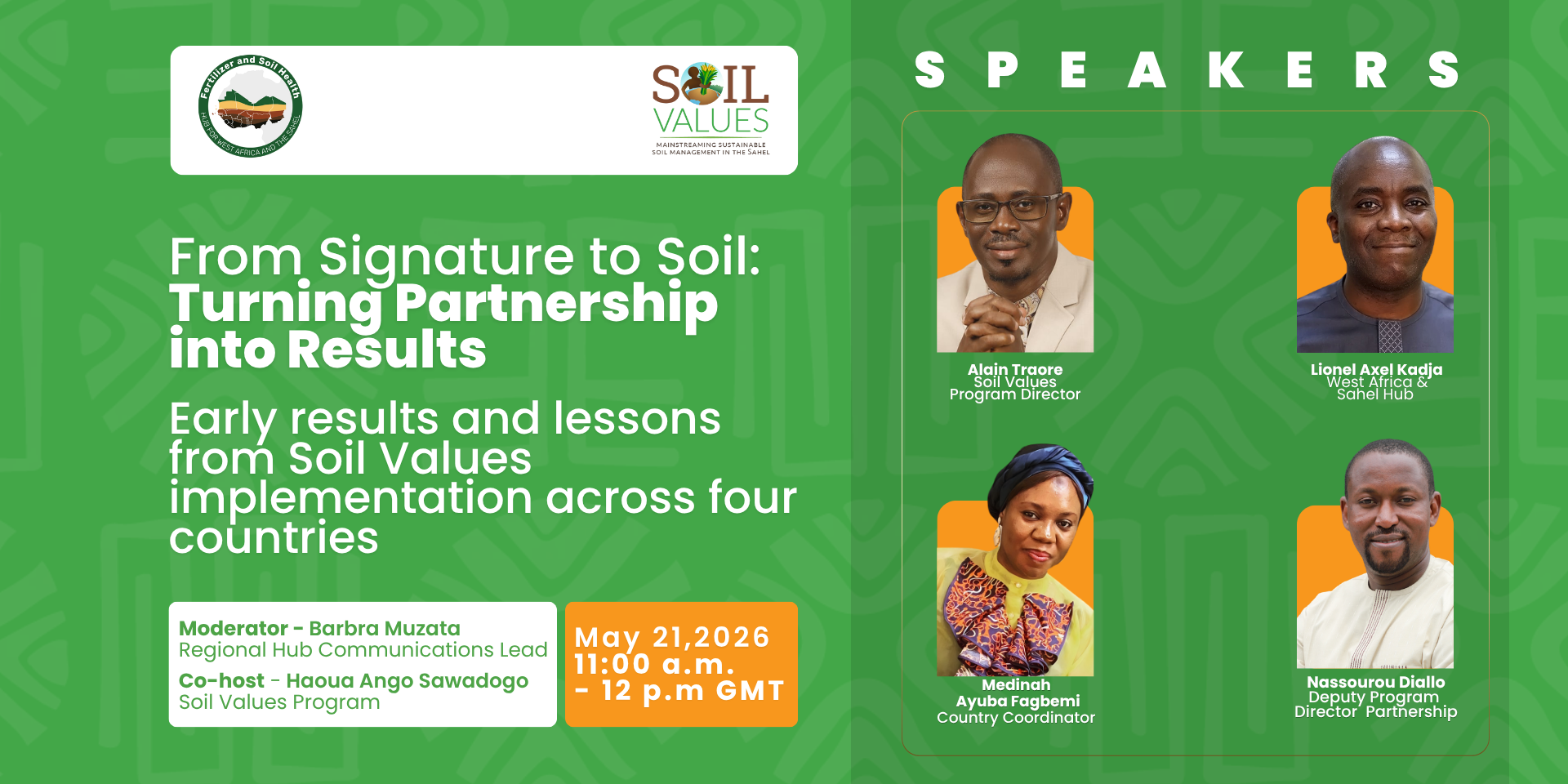
Just three months after formalizing a strategic partnership under the Coalition of Implementers for Fertilizer and Soil Health (CIFSH), the Regional Hub for Fertilizer and Soil Health for West Africa and the Sahel and the Soil Values Program convened stakeholders for a results-focused webinar showcasing how collaboration is already translating into action across the Sahel.
Held on May 21, 2026, the webinar, themed “From Signature to Soil: Turning Partnership into Results,” brought together 268 participants from West Africa, Europe, and beyond, including consortium members, technical experts, development partners, research institutions, and implementing organizations. The session reflected a growing commitment among institutions to move beyond parallel interventions toward more coordinated and complementary action on soil health and sustainable agriculture.
The webinar built on the Memorandum of Understanding (MoU) signed on February 26, 2026, at the International Institute of Tropical Agriculture (IITA) headquarters in Ibadan, Nigeria. The agreement marked the operational launch of a strategic collaboration between the Regional Hub for Fertilizer and Soil Health and the Soil Values Program to accelerate soil health restoration, strengthen soil information systems, and improve sustainable fertilizer use across the Sahel.
Moderated by Barbra Muzata, Communications Lead for the Regional Hub, and co-hosted by Haoua Ango Sawadogo, Communications and Knowledge Management Manager for the Soil Values Program, the 60-minute session highlighted how both initiatives are aligning technical expertise, investments, and field-level implementation efforts to address soil degradation and strengthen food systems resilience.
Opening the session, Nassourou Diallo, Deputy Program Director for Partnerships and Private Sector Engagement at Soil Values, emphasized that many countries in West Africa continue to face challenges related to fragmented soil information systems, weak laboratory capacity, and limited coordination among institutions. He explained that the partnership was designed to bridge these gaps through joint action at country, technical, and regional levels. He further highlighted that the collaboration includes joint development of soil information systems, technical support to national systems, work on fertilizer recommendations adapted to crops and soils, and collaborative activities on digital soil mapping, nutrient recommendation systems, data management, and capacity strengthening.
The webinar also showcased concrete progress already underway in Nigeria through joint implementation activities in the Komadugu-Yobe and Yartiti watersheds. Medinah Ayuba Fagbemi, Soil Values Country Coordinator Nigeria, presented updates on several technical activities being implemented jointly by Soil Values, the Regional Hub and other partners.
These activities include the implementation of standardized multi-layer soil sampling protocols, the development of digital fertilizer recommendations using nutrient omission trials, digital soil mapping, and the identification of soil degradation hotspots to guide restoration interventions. Discussions also highlighted the ongoing development of the “Bundle Box” pilot approach, designed to connect farmers with integrated agricultural services, financial institutions, agro-input suppliers, and technical support systems.
Initial field results have already demonstrated significant progress. Soil sampling campaigns have been conducted across the intervention watersheds, nutrient omission trial plots have been established for maize and rice, and the first version of digital soil maps and nutrient recommendation tools is under development to support evidence-based soil fertility management.
Speaking on the broader regional vision, Alain Sy Traoré, Program Director of Soil Values, emphasized that while current interventions are focused on the Sahel, which are most affected by climate shocks and land degradation, expansion is already underway toward countries such as Ghana, Senegal, Togo, and Côte d’Ivoire.
According to him, the experiences and successes generated in the initial intervention countries are expected to serve as replicable models across the wider West African region.
Lionel Axel Kadja, Director of the Regional Hub for Fertilizer and Soil Health in West Africa and the Sahel, stressed the importance of unity and coordinated action in addressing soil degradation and food system challenges affecting nearly 500 million people across the region. In his words, “We have to show good examples of unity, coming together and joining forces to combat issues facing our population. If this model of cooperation works in these four countries, it could be a very good example to emulate in other geographies of West Africa.”
He noted that soil health must be treated not only as an agricultural issue, but also as a shared societal and human responsibility requiring collective action.
The Soil Values Program, funded by the Netherlands Directorate-General for International Cooperation (DGIS), is being implemented from 2024 to 2033 with the objective of mobilizing more than €300 million, restoring 2 million hectares of farmland, and directly benefiting 1.5 million farmers, including 800,000 women. The initiative is led by the International Fertilizer Development Center (IFDC) in consortium with the Netherlands Development Organization (SNV) and Wageningen University & Research (WUR), alongside knowledge partners including AGRA, International Institute of Tropical Agriculture (IITA), the Center for International Forestry Research and World Agroforestry (CIFOR-ICRAF), World Soil Information (ISRIC), and the International Water Management Institute (IWMI).
The Regional Hub for Fertilizer and Soil Health for West Africa and the Sahel brings together leading research, development, and private-sector partners to deliver science-driven solutions for sustainable agriculture. Hosted by IITA, the Hub is supported by organizations including IFDC, OCP Africa, the African Plant Nutrition Institute (APNI), University Mohammed VI Polytechnic (UM6P), Accelerating the Impacts of CGIAR Climate Research for Africa (AICCRA) and International Soil Reference and Information Centre (ISRIC) to leverage data, soil testing, and fertilizer technologies to enhance productivity, efficiency, and resilience across regional food systems.
Institutions represented during the webinar included IFDC, SNV, Wageningen University & Research (WUR), AGRA, IITA, CIFOR-ICRAF, ISRIC, IWMI, APNI, OCP, Mohammed VI Polytechnic University (UM6P), and other members of CIFSH, reflecting the breadth of collaboration underpinning the initiative.
Looking ahead, the webinar marks the beginning of a structured series of technical engagements aimed at strengthening regional collaboration and accelerating impact across the Sahel, including a forthcoming session focused on the Bundle Box model, pathways for scaling, and policy integration across countries.
As implementation expands, the emphasis is increasingly shifting from alignment to acceleration, ensuring that shared tools, coordinated investments, and joint learning translate into measurable improvements in soil health and agricultural productivity across West Africa and the Sahel.
About Soil Values Program
Funded by the Netherlands Directorate General for International Cooperation (D.G.I.S), Soil Values Program addresses persistent soil fertility challenges in the Sahel region, namely Burkina Faso, Mali, Niger, northern Nigeria, with strategic countries: Ghana and Côte d’Ivoire. Soil Values Program aims to strengthen soil fertility and agricultural productivity, in the face of climate change, with a focus on regional connectivity and strategic interventions. The program aspires to create a lasting impact on desertification and land degradation, landscape management – watersheds through participatory planning, effectively integrating soil, water and biodiversity. Soil Values Program plans to promote financial incentive instruments that encourage farmers to invest in soil health through the adoption of sustainable soil management practices. The Soil Values Program is being implemented over 10 years (2024-2033), led by the International Fertilizer Development Center (IFDC), in consortium with SNV and Wageningen University and Research (WUR), as well as knowledge partners such as AGRA, the Center for International Forestry Research and World Agroforestry (CIFOR-ICRAF), the International Institute of Tropical Agriculture (IITA), ISRIC – World Soil Information, and the International Water Management Institute (IWMI).
About the Regional Hub
Le Pôle régional pour la fertilisation et la santé des sols en Afrique de l'Ouest et au Sahel est une initiative collaborative qui réunit des partenaires de premier plan issus de la recherche, du développement et du secteur privé afin de proposer des solutions scientifiques pour une agriculture durable. Hébergé par l'Institut international d'agriculture tropicale (IITA) et soutenu par des organisations telles que le Centre international de développement des engrais (IFDC), OCP Afrique, l'Institut africain de nutrition des plantes (APNI), l'Université Mohammed VI Polytechnique (UM6P), le projet AICCRA (Accélération des impacts de la recherche climatique du CGIAR pour l'Afrique) et le Centre international de référence et d'information sur les sols (ISRIC), le Pôle exploite les données, les analyses de sol et les technologies de fertilisation pour améliorer la productivité, l'efficacité et la résilience des systèmes alimentaires régionaux. Grâce au soutien financier de la Banque mondiale, via le projet AICCRA du CGIAR et OCP Afrique, le Pôle s'engage à traduire la recherche en solutions concrètes pour les agriculteurs et les décideurs politiques, favorisant ainsi la santé des sols, la sécurité alimentaire et le développement durable en Afrique de l'Ouest et au Sahel.
Media Contacts
Ilerioluwa Oladipupo
I.Oladipupo@cgiar.org
Evariste Gbaguidi
soilvalues@ifdc.org